SEO vs AI
📌 Disclaimer: although this article is written in English, all searches and queries were conducted in Italian. Results may vary in other languages.
We are living in the AI era, and the further we go, the more artificial intelligence will be part of our lives, especially for those who work in certain fields. In the e-commerce sector, AEO and GEO have been topics of conversation for a while now: but what will happen to SEO? Will it still make sense to work with an SEO-oriented mindset? I have been studying Search Engine Optimization since 2018 and have become deeply passionate about it. Lately, though, the question that was troubling me most was this: is SEO destined to die with the rise of AI? It is a concern of mine, and that is why I decided to spend some time on it, not just by taking courses or reading other people’s research, but by building a test myself. he idea is simple: take one real query pulled from Google Search Console and create one from scratch, both related to sites I work on, and see how they perform on Google, Bing, and the main AI tools: ChatGPT, Perplexity, Gemini, and Claude.
⚠️ I included the latter in the test, even though it was not possible to use it in incognito mode (or at least I couldn’t figure out how!), a limitation to keep in mind when reading the results.`
Test 1: “Nuovi occhiali da vista Dolce & Gabbana 2026”
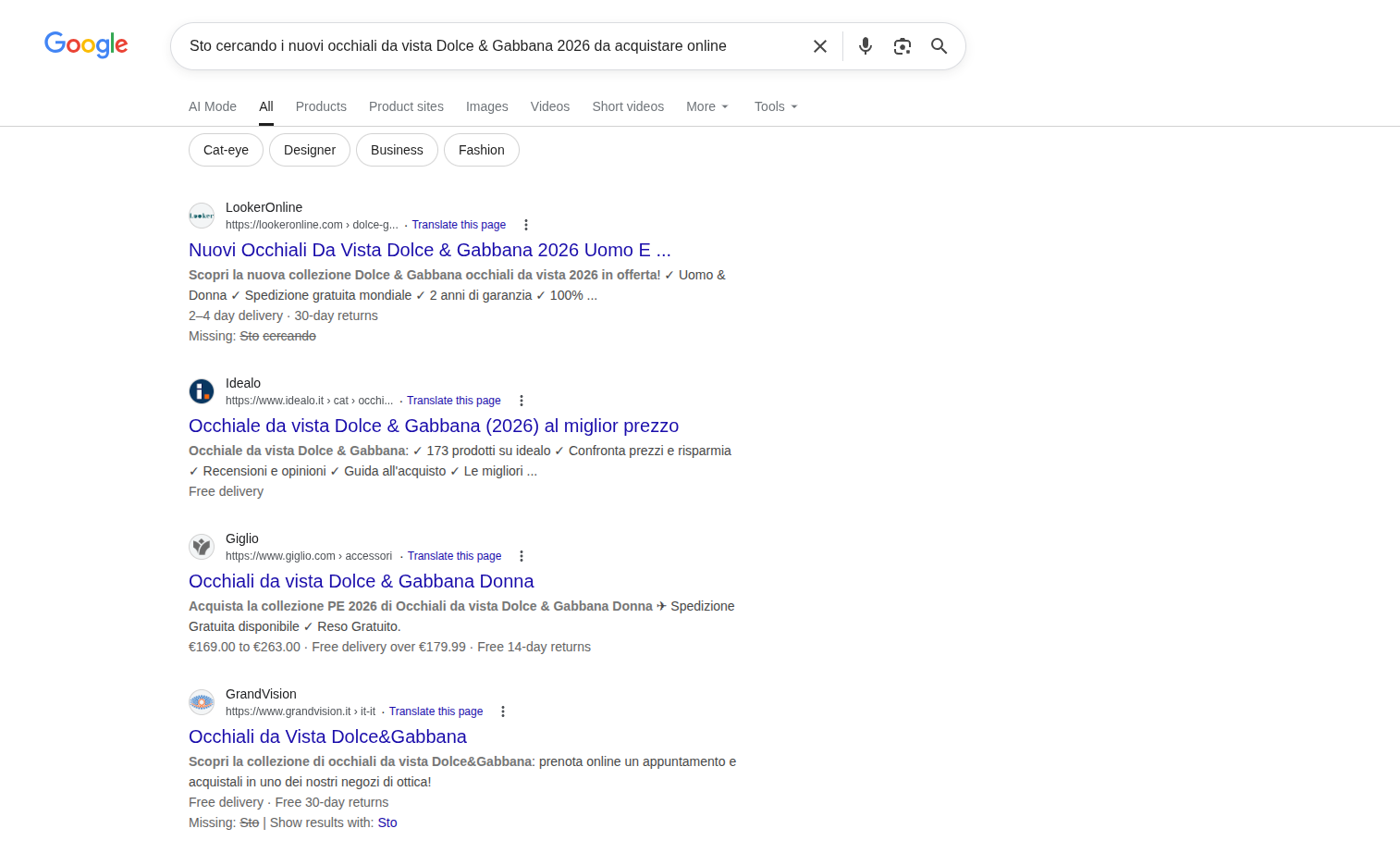
The first query is extracted from Google Search Console and is one where LookerOnline ranks in first organic position.
The page opens with a Shopping carousel: no AI Overview, which has its own logic. For a fashion query, Google bets on visual impact and puts images, prices, and retailers directly on the first page.
Among the sponsored products at the top are Otticabarile, Adrialenti, Amevista, and Stileo, but not LookerOnline. Yet it is precisely LookerOnline that claims the first organic result, with the Men & Women category page, a title centered on the query, and a description highlighting its strengths: worldwide free shipping, two-year warranty, delivery in 2-4 days.
Right after, Instagram videos from local optical shops appear: Google mixes formats to address multiple angles of the same search.
🟠 Bing
Here too, the search engine understands the user’s purchase intent and the first thing that catches the eye is the Shopping carousel. The first ‘search’ result is Amazon, the other two are two blogs: occhiali di lusso and occhiali da sole donna.it. In this case, LookerOnline does not appear.

🟣 Claude
Prompt used: “I am looking for the new Dolce & Gabbana eyeglasses 2026 to buy online.”
The response was an overview of the autumn/winter 2025-2026 collection: square frames, quality acetate, baroque elements, bold colorways, followed by a list of sites where to buy. Among these, LookerOnline is explicitly mentioned with a specific reason: free shipping and new collections at the best price. The other sites in the list include the official D&G website, Quivedo, Ottica SM, and Idealo as a price comparator
⚠️ It is worth noting that OtticaSM has blocked ClaudeBot in its robots.txt, yet it still appears in the results.
This suggests a key point:
the presence of a site in AI responses does not depend exclusively on direct crawling, but also on pre-existing data or third-party sources used by the model.

🟢 ChatGPT
Same prompt, more structured approach. The response is organized into distinct sections: a selection of specific models with descriptions (DG5026, DG3437, DG3419, DG1367B, DG3443), an indicative price range (€100-€280), 2026 trends, and finally the recommended sites for purchase.
The most relevant data point is here: the first link inserted leads directly to LookerOnline, presented as the main reference for the 2026 collection, even before price comparators like Idealo. Notably, ChatGPT does not just list site names — it embeds direct links, so the user can land on the page in one click, with no need to search further.
ChatGPT also spontaneously adds a “Tips before buying” section. Measurements, prescription lenses, free returns, watch out for fakes. A consultant’s approach, not a search engine’s.

🔴 Gemini
The approach is different again: first a list of 2026 trends and news, without citing sources. Among the recommended e-commerce sites are LookerOnline, Salmoiraghi & Viganò, and two new entries like Vision Factory and Adrialenti.
The response closes with a technical tip and a question to the user about what type of frame shape they prefer, as if actively trying to guide them toward a purchase.

Test 2: “Mi trovo a Grosseto ed ho bisogno di un ottica. Quale mi consigli?”
Made-up query
The second query is completely different in nature: no longer transactional and branded, but conversational and local. No brand, no product — just a user who finds themselves in a city and asks for advice.
Google immediately interprets the question as a local search and responds with an AI Overview that takes up the entire top of the page. It does not simply list shops: it organizes them by geographic area, distinguishing optical stores in the historic center from those in other parts of the city, adding for each one the address, Google Maps score, and a brief description. It is a ready-made answer that does not invite the user to click anywhere.
Traditional organic results only appear below, but they are completely disconnected from the query: an optician from Livorno, a ranking of camera lenses, a Facebook post from the local health authority.

🟠 Bing
On Bing the same question gets a completely different response. No AI Overview, no neighborhood-based organization — just a list of traditional organic results dominated by the major category aggregators: PagineBianche, PianetaOttici, PagineGialle, ottici.it, Cylex. Some local optical shops from Grosseto also appear — Ottica Di Luzio, Ottica New Vision, Ottica Ricasoli, Blu Optik — but without any hierarchy or additional context.
It is an “old-school” SERP: the user receives a list of links and has to figure out on their own which shop suits them. Bing does not try to answer the question — it defers it.

🟣 Claude
Claude draws directly from Google Maps data and returns a response with an interactive map of the optical shops already pinned on the city.
The selection is based on reviews: at the top is Ottica Ingenium with a perfect 5.0, followed by Bottega Ottica Ricasoli and Ottica di Luzio, both at 4.8. For each one, address, phone number, and opening hours are provided. There is even a practical note about Sundays, highlighting Blu Optik as the only option open with continuous hours.

🟢 ChatGPT
ChatGPT goes one step further than all the others: it does not just list the optical shops, it categorizes them by use case. Ottica Di Luzio if you want full quality, Bottega Ricasoli if you are in a hurry, occhiali24.it if you are looking for style and variety, Ottica Ingenium for specific technical needs. It is almost personalized consulting, not a simple list. Here too a map appears, but the real added value is the final “quick recommendation”: a decision table that in four lines helps the user choose without reading the rest.
It is worth highlighting a detail that emerges from this test: both Claude and ChatGPT draw from Google Maps data for local queries. This means that visibility in this type of search depends first and foremost on the Google Business Profile of the physical store — not the website, not traditional SEO, not GEO. An additional layer to keep in mind.
Curious about some details of this approach, I asked ChatGPT exactly what it was basing itself on. The answer was honest: the model admitted to having mixed verifiable facts — addresses, services declared on official websites, directory pages — with its own inferences, presenting them with the same assertive tone. For example, defining occhiali24.it as the best choice “for design and style” was an impression drawn from the site’s commercial setup, not an objective fact. ChatGPT acknowledged this and spontaneously offered a more cautious and documented version.
⚠️ AI tools can seem far more confident than their data justifies. The response was fluid, structured, almost authoritative — but underneath there was a layer of narrative construction. Only by explicitly asking for sources does the distinction between what is verified and what is assumed emerge. At least, that is how it went in this case.


🔴 Gemini
Gemini lays its cards on the table right away: at the top the source Google Maps appears, indicating that the response comes directly from the Google ecosystem. It is no surprise — Gemini and Maps are products of the same company — but seeing it written explicitly says a lot about how GEO works within the Google universe.
The comparison with the AI Overview is illuminating precisely for this reason. Both draw from the same data, yet the result is different: the AI Overview organizes the optical shops by geographic area, distinguishing the historic center from the outskirts; Gemini instead sorts by rating and adds two names the AI Overview had not mentioned — Salmoiraghi & Viganò for those looking for a chain with a wide brand selection, and OTTICA COOP for those who need continuous opening hours until 8:30pm, Sunday included.
Same source, same ecosystem, different selection and presentation algorithms. A detail that dismantles the idea that “Google” is a single unified answer: even within the same company, visibility depends on how and where the question is asked.

Conclusion`
SEO is still very important, essential, even. If anything, it may be more important than ever. Especially when it comes to Google: as the first test shows, in our case a query that ranks on the first page tends to be cited by the AI tools we tested. The second test, being local in nature, shifts the weight onto the Google Business Profile: Ottica Di Luzio is the constant, present both in the SERPs and in the AI responses. Here too, good local SEO makes the difference.
It is worth being clear about one thing: the data we have is limited: two queries, two sites, searches conducted in Italian. It is not possible to generalize in absolute terms, but the signal is clear enough to draw a practical takeaway. Given the contrasting results observed on Bing in this first experiment, next time I will take a query directly from Bing Webmaster Tools—where the site already has a strong ranking—to see how these AI tools behave when the starting point is different.
My advice? If you want AI tools to mention your site, keep pushing on SEO. Work on AEO and GEO as well, of course, but SEO remains a solid foundation that gives you a good chance of appearing in AI responses too. It is not dead. It has become even more important.